
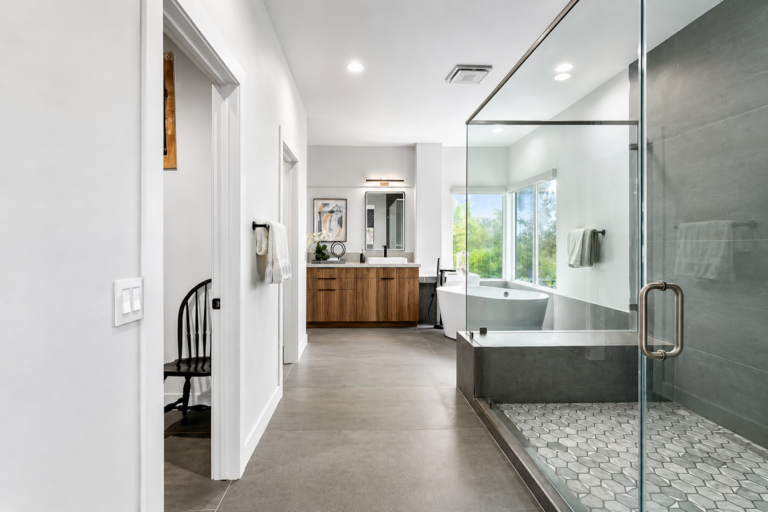
The bathroom used to be the last room homeowners renovated. In 2026, it is often the first. Zillow’s 2026 Home Trends Report found spa-inspired bathrooms appearing 22% more often in listings. Mentions of wellness features rose 33% year-over-year. The NKBA’s 2026 Bath Trends Report adds more weight: 72% of industry experts expect bathroom footprints to grow. 89% prioritize space allocation in the primary bath. Bathroom remodel trends in 2026 reflect a clear shift — away from renovation theater, toward environments that actively restore. Substrata Construction applies this principle to residential bathroom projects across Los Angeles. Here is what it looks like in practice.
The Restorative Bathroom: What It Actually Means
A restorative bathroom is not defined by fixtures or price tag. It performs across daily use — that is what defines it. HomeWorldDesign’s 2026 LA remodeling report describes this shift directly. Bathrooms now function as private spaces for restoration. They are not purely functional rooms. Remodels focus on simplicity and comfort. Storage integrates carefully so surfaces stay clear. The result supports daily rituals rather than demanding attention.

The design question has changed. It is no longer “what looks impressive?” It is “what supports this person’s actual morning and evening routine?” The NKBA confirms the shift: bathrooms are evolving from standardized luxury toward deeply personalized spaces. They now reflect individual lifestyles, routines, and aesthetic preferences. That single change reshapes every decision — materials, lighting, storage, fixture placement, and spatial organization.
Key Design Elements: Lighting, Materials, Restrained Palettes
Lighting That Adapts to the User
Most bathroom lighting fails at its primary job. A single overhead fixture floods the room with flat, high-contrast light. It works for tasks. It works for nothing else. Spa bathroom design in 2026 layers lighting across three functions. Ambient light covers the overall space. Task light serves the vanity mirror. Accent light sets atmosphere. Each layer operates independently on separate controls.
A person entering the bathroom at 11pm needs a fundamentally different environment than one doing makeup at 7am. The BAID’s 2026 interior design trends report confirms this approach. Layered and zonal lighting schemes that adapt to the user are a defining wellbeing principle this year. Lighting temperature matters equally. Cooler light triggers alertness. Warmer light supports relaxation. Specify warm-toned sources for a wellness bathroom environment.
Natural Materials Over Synthetic Uniformity

The NKBA’s 2026 Bath Trends Report identifies warm metals and natural materials as the dominant direction. Brushed brass, gold, and bronze hardware in softer finishes replace chrome and polished nickel. Large-format natural stone tile — with visible veining — reinforces the organic material connection. USA Cabinet Store’s NKBA-aligned data confirms floating vanities in warm wood tones as a leading specification. They replace the all-white cabinetry that dominated the prior decade.
The material principle is consistency over variety. Restrained, earthy palettes build interest through texture — not color contrast. A bathroom using three materials with clarity outperforms one using eight materials with chaos.
Showers and Bathtubs: The 2026 Design Directions
Showers: Curbless, Oversized, Steam-Ready
The NKBA’s 2026 Bath Trends Report confirms the majority of renovating homeowners now choose showers over bathtubs. The shower itself has changed significantly. Homeowners want extra-large showers with steam options. Built-in seating and curbless entry are now standard expectations. HomeWorldDesign confirms the framing preference: minimal framing, thoughtful proportions, typically a single glass panel.

The curbless design serves two purposes simultaneously. It makes the shower accessible for all household members at every stage of life. It also delivers the clean, open aesthetic that defines spa bathroom design. Aging-in-place and luxury converge on the same specification. Substrata applies this standard to every bathroom renovation involving shower reconfiguration.
Freestanding Tubs: Returning as a Centrepiece
Freestanding tubs are making a significant comeback in 2026. Interior designer Mikel Welch states it plainly: “Homeowners want ritual and restoration, and the bathtub is returning as a sculptural centerpiece, rather than an optional feature.” Zillow’s 2026 data supports this. Spa-inspired bathrooms — where freestanding tubs anchor the design — appear 22% more frequently in listings than in the prior year.
Positioning matters as much as selection. The tub needs a clear sightline from the door. It needs adequate floor clearance on three sides. It cannot block the primary circulation path. A freestanding tub wedged into a corner because the footprint does not support proper placement produces the opposite of the intended effect.
Storage and Calm: Integrated Storage as a Design Principle
Surface clutter defeats a restorative bathroom regardless of material quality. A counter covered with products and tools eliminates any sense of calm. Integrated storage removes this problem at the design stage. It requires no behavioral discipline from the occupants.
HomeWorldDesign identifies integrated storage as a core 2026 LA bathroom design principle.
Specifically: deep drawer banks with internal organizers sized for actual products, recessed medicine cabinets that clear the countertop without adding visual bulk, and tower units that add vertical capacity without consuming floor space. USA Cabinet Store’s NKBA-aligned reporting confirms tower storage and mood lighting as two defining spa-inspired elements in 2026 bathroom remodels.
The design standard is simple. Storage should be invisible in use. A flush-closing drawer, a cabinet that disappears into the wall plane, a niche that holds shampoo without interrupting the tile pattern — each reduces visual noise without requiring behavior change. That is the standard Substrata applies to every bathroom project.
Wet Rooms: The Honest Assessment
The outline presents wet rooms as a rising luxury trend. The 2026 data presents a more complicated picture. The 2025 Zillow report found wet rooms in listings 19% more often. That made them a documented 2025 trend. Multiple 2026 sources show them declining in favor of warmer, more enclosed designs.

The core problems are functional. A fully open wet room makes the entire bathroom damp after every shower. Keeping towels and paper dry becomes a daily challenge. Without exceptional ventilation, mold and mildew accumulate. The fully open format also loses enclosed steam — which is precisely what makes a luxury shower experience feel luxurious. 2026’s design shift toward warmth and coziness directly conflicts with the wet room’s fully open format.
For high-end renovations with large footprints and dedicated ventilation systems, wet rooms remain a viable option. For most Los Angeles residential bathrooms, an oversized curbless shower with a single glass panel delivers the same spa aesthetic. It also avoids the operational problems. Substrata presents both options to clients. Each comes with an honest assessment of what it demands operationally — not just what it looks like on launch day.
Conclusion: Substrata’s Approach to Restorative Bathroom Design
Bathroom remodel trends in 2026 converge on one principle. Design for the person using this space every day — not for the listing photo it will eventually produce. Layered lighting, natural materials, integrated storage, oversized curbless showers, and thoughtfully positioned freestanding tubs all serve the same goal. They build a bathroom that actively restores rather than merely functions.
Substrata Construction applies commercial-grade construction discipline to residential bathroom projects in Los Angeles. That means correct waterproofing before tile goes down. It means proper ventilation specified before fixture selection. It means storage integrated at the framing stage — not retrofitted as an afterthought. The result is a wellness bathroom built to perform at the level its design promises.
Ready to design a bathroom that earns daily use? Contact Substrata to discuss your scope and how our construction expertise delivers spa bathroom environments built to last and built to restore.


